
Introduction
This article seeks to provide an overview and contemporary contextualization of the Native Resource Management Program Summary Report for 1995 (Morrow, 1995). Described as an “information package,” the report summarizes the activities and accomplishments of the Native Resource Management Program (NRMP), an initiative which centered around providing introductory training for local Native individuals – largely members of the Secwepemc Nation’s constituent bands – to encourage their participation and career-development within natural resource management sectors. My father Allan Casimir – a Kamloops Indian Band (KIB) member and former Kamloops Indian Residential School attendee who served as Range Manager for the band from approximately 1983 to 1998 – was key within the program’s development and implementation (see Figure 1 for a photograph of him with NRMP program graduates).
Initially near-solely focused upon the provision of fire-suppression training in its early iterations, the NRMP expanded its purview to encompass more holistic aspects of forest stewardship while maintaining fire management as a primary emphasis within course content (Morrow, 1995). A then-recent 1994 program featured a week specifically centred on fire management, with training days respectively dedicated to handguard construction, fire-line organization, and prescribed fire planning. In addition, forms of natural resource management consistent with increased wildfire resistance, such as minimization of fuel-continuity via spacing and pruning, served as important components of program content.
The contents of the NRMP summary report are summarized, reorganized, and evaluated here to offer an accounting of the possibilities of future Native-led fire-resilience-centred action implied by the program’s development, design, and accomplishments (Morrow, 1995). To evaluate the NRMP through a relatively contemporary lens of wildfire resilience, components of the program as described are considered in relation to three key conditions identified by Abrams et al. (2015) as integral in “the project of creating more fire-resilient human communities” (p. 3), and the NRMP’s import is ultimately framed in light of recent discourse on the reincorporation of Native fire stewardship into land management as a means of reducing frequency and severity of wildfire occurrence (Hoffman et al., 2022).
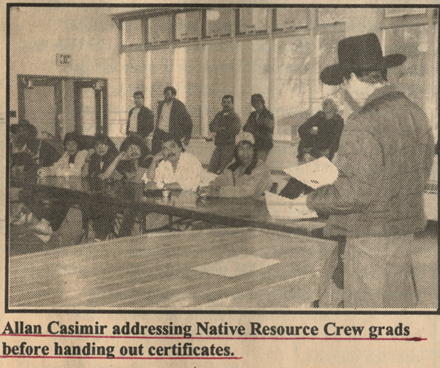
Figure 1. Photograph printed in March 1993 Lex’yem Newsletter showing Kamloops Indian Band Range Manager Allan Casimir with NRMP/Native Resource Crew graduates.
Program Development – 1992 to March 1995
Training courses conducted under the NRMP are described within the report as having been organized into distinct introductory and advanced stages, with the latter entailing more specialized training geared towards graduates of the introductory programs – of which six iterations had been completed as of the report’s publication (Morrow, 1995). Training structure emphasised practical field exercises as a primary means of communicating course content, composing approximately 60% of course time with the remainder dedicated to in-class learning.
Initial NRMP programs in 1992 centered around fire suppression and chainsaw-handling training to support local Natives in Kamloops and Salmon Arm to attain positions with locally-sited Ministry of Forests (MOF) Unit Crews conducting seasonal fire suppression work (Morrow, 1995). Program success was considerable, with 20 of 34 program enrollees – primarily members of Kamloops Indian Band – subsequently hired on as MOF Unit Crew members. A policy was additionally instituted on the part of the Kamloops Forest District to require NRMP introductory training completion as a condition for MOF Unit Crew employment going forward.
A third iteration of the program was supplemented by tree identification and map-and-compass components with the intention of developing Unit Crew capacity for between-fire project work – additions which, following their enthusiastic reception by participants, served to substantially re-centre the structure and content of subsequent course iterations (Morrow, 1995). A new holistic focus upon forest management became a defining feature of the program in 1993, in part to better support the development of the newly-formed Native Resource Crews (NRC) seeking local employment in spacing-focused silvicultural contract work (see Figure 2 for a visual depiction of a typical NRC crew).
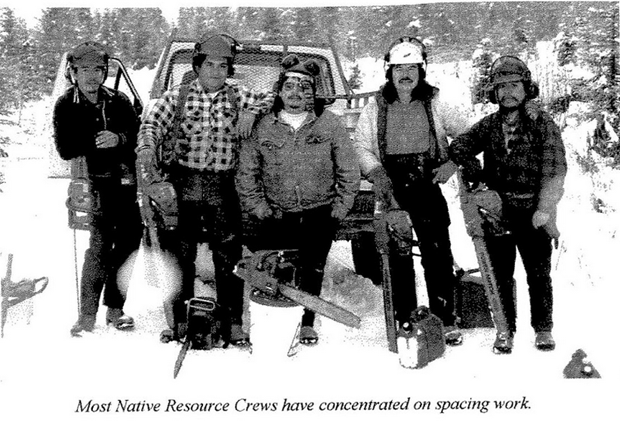
Figure 2. Photograph printed within NRMP summary report displaying a five-person Native Resource Crew, with a caption describing their primary concentration on spacing work.
Native Resource Crews
Native Resource Crews (NRC) – a notable outcome of NRMP training programs – were five-person “self-supporting” work groups, generally band-sponsored (Morrow, 1995). NRC crews, as described within the summary report, were centred around the completion of forestry-related contract work for local license-holders, conducted on land-plots held by local forestry companies. In contrast to seasonally limited MOF Unit Crew positions, NRC employment potentially followed a full-time, year-round schedule, depending upon weather conditions and work availability. Beyond their completion of introductory (and potentially advanced) levels of NRMP training, NRC crewmembers participated in additional MOF-sponsored training programs, intended to further steward and enhance their sector-specific competencies – rendering NRC crew membership as one potential pathway through which advanced-level environmental-career development could be pursued by NRMP graduates.
Coverage of the NRC crews within the summary report also indicates attention to perceived issues with then-current group organizations, with a looseness of organizational rigour – credited to an absence of consistent leadership and supervision – identified as a core weakness in need of address, in addition to a lack of band support (Morrow, 1995). It is further noted that initial work among NRC crews largely entailed physically intensive spacing work for which many crew members were not adequately prepared via training or past experience to implement “on a production basis.” Such observations of incomplete preparedness contextualize the advocacy for secondary/advanced-level forestry training articulated elsewhere within the report.
The NRMP’s program design, guiding values, and facilitated integration
A holistic and purposeful set of values, ethics, and practical understandings guiding the NRMP’s design are articulated through the course of the summary report, in a manner distinctly broad-viewed and anticipatory in accounting for the complexity of engendering increased Native professional involvement within natural resource sectors (Morrow, 1995). A pragmatic view of the implications and limitations of NRMP training is additionally displayed, with proffered acknowledgement that NRMP courses are to be understood as foundational – and therefore necessarily partial – in their scope, figuring as preparatory points of departure to engender interest in natural resource work among Native people rather than self-contained ends in themselves. Further, understanding the NRMP in this light – as a jump-off point unlikely to produce well-rounded forestry workers on its own – is framed by the report as key to its eventual success. Towards this end, although introductory NRMP training programs were initially centred solely around preparing trainees for employment with MOF and/or NRC work crews, a deliberate expansion of identified post-program pathways was subsequently explored to better encourage engagement in advanced levels of long-term sector-relevant training and natural resource work beyond those two options (as illustrated in Figure 3) . An expansion of the then-extant two-level Forestry Worker Development Program – at that time limited only to those unemployed long-term – to include Native groups “regardless of recent employment status” (p. 10) is suggested as a potential source of secondary/advanced training. A locally-specific community-scale approach in developing the particulars of program iterations is put forth as a necessary condition within the report, with individual bands necessarily tasked with determining and advocating for their unique contextually-mediated needs, identifying thereby the configuration of capacity-development most appropriate for their circumstances, with community-scale recruitment conducted by designated forestry representatives serving on each respective band’s council.
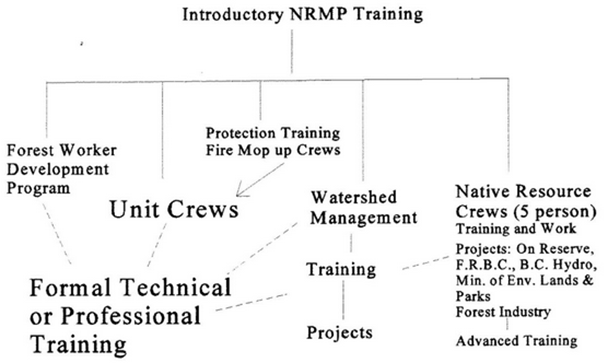
Figure 3. Diagram, originally appearing in the 1995 summary report, demonstrating the diversity of employment and training opportunities available for NRMP graduates.
Analysis of the strengths and limitations of forestry-centred training programs beyond the NRMP is also undertaken within the report towards an end of better supporting and optimizing long-term and widespread Native involvement in forestry work (Morrow, 1995). The Forest Worker Development Program, while looked to as a potential source of secondary training for NRMP graduates, is also critiqued in part for its substantial focus on spacing – framed as a uniquely intensive and difficult component of forestry work – on the basis that such a pointed and accentuated focus may ultimately discourage the entry and retention of participants within the program – and therefore within the forestry and natural resource sectors more broadly. Such critiques speak to an understanding of natural resources as a varied sector subject to equally various learning-curves for which long-term participation and excellence requires support, experience, and specialization. Such an evaluation contrasts strikingly with common production-centred, functionally exclusionary attitudes which stress the retention only of participants already unusually competent as a function of their upbringing, past experience, and/or particular mental capacity.
Towards addressing and working with these acknowledged entrance barriers, the development of a bridging-in system, designed to better secure conditions facilitative of increased Native competitive involvement in natural resource work, was instituted (Morrow, 1995). This system as described provided for the award of initial direct contracts to Native bands, crews, and independent companies at an approximate 30% increase above industry standards to allow for additional training and work-duty familiarization – allowing for the gradual initiation of what the report terms ‘green’ crews to support their eventual direct and self-supported participation within forestry/natural resource contracting markets. Ultimately, in reviewing the particulars and justifications of program design detailed within the report, the impression received is of a comprehensive, continuously revised program of gradually accumulating efficacy through which all possible barriers to Native forestry involvement can be anticipated and treated. An early section in the report outlining the program’s guiding principles identifies a “need to be humble and sensitive to each and others involved, whomever they may be” (Morrow, 1995, p. 2), an ethic from which a resilient and mutually supportive structure may be extrapolated).
The lens of adaptive governance and community wildfire resilience as applied to the NRMP
The NRMP occurred within a 1990s context in which frequency and severity of wildfire disaster occurrence, while elevated relative to the previous decade, had not yet reached the highs of the 21st century; as estimated by Tymstra, et al. (2020), the approximate number of Canadian wildfire disasters occurring between 2011-2017 was more than double that of those occurring within the 90s. Shifting understandings of the import of wildfire risk resulting from these developing circumstances have engendered what Abrams et al. (2015) refer to as a “robust body of scholarship” (p. 1) concerned with the theory and development of community-scale wildfire resilience. Towards refining this developed body of scholarship to better acknowledge the importance of multi-scale institutional factors in supporting and maintaining strong community wildfire resilience, Abrams et al. (2015) sought to integrate three key conditions associated with strong adaptive governance and resilience more generally. The three conditions were scale-matching – meaning that decisive actions and the outcomes and responsibilities following therefrom are centred within a single (i.e. community) scale; linkage between scales – referring to mutual knowledge-sharing and collaboration conducted both within and across community/local/regional/provincial/federal scales, and institutional flexibility – the structuring of institutions to allow for revision and adaptation in response to new information and shifting needs (Abrams et al. 2015).
With respect to scale-matching, the NRMP notably prescribed – as a necessary condition of involvement – the active direction of local band-employed Field Zone Coordinators in determining community-specific needs to guide locally relevant, locally-sited programs of community-scale training and eventual employment (Morrow, 1995). As a result, rather than imposing a single standardized program of training – developed at the scale of a specific community, or in reference to the averaged needs of a broad region – for application across the distinct communities within the Secwepemc Nation, program decision-making was pointedly formed in response to the unique circumstances of the participating community (Abrams et al. 2015).
With regard to within-and-across-scale linkage, the NRMP is stated to have originated in 1990 from efforts taken to train KIB members for employment with MOF Unit Crews, a process soon expanded to service the broader Shuswap – or Secwepemc – nation to which the band is part, thereby providing basic and meaningful linkage through employment between community members and local government agencies (Morrow, 1995). Further, NRMP-centred working groups comprising representatives from First Nations, government ministries, and natural resource industries functioned as valuable avenues for collaborative multi-scale program development. A brief 1993 report on the NRMP’s progress published in the KIB Newsletter Lex’yem contains an extensive list of industry, government, and First Nations collaborators framed as essential to the program’s development, including representatives from MOF, local forestry company Weyerhaeuser, and both provincial and national Native forestry organizations, framing the program’s successes as uniquely dependent on an interconnected network of actors and institutions existing at various scales (see Figure 3 for a photograph of key NRMP coordinators) (Casimir, 1993). It is additionally noted within the report that for many participants, introductory NRMP programs constitute their initial point of contact with community-oriented training, thereby serving as potentially valuable channels to promote enrollment within additional industry-and-government-run programs (Morrow, 1995). It’s also implied – but not clearly stated – that the provincial crown corporation Forest Renewal BC had been a source of funding for NRMP programming.
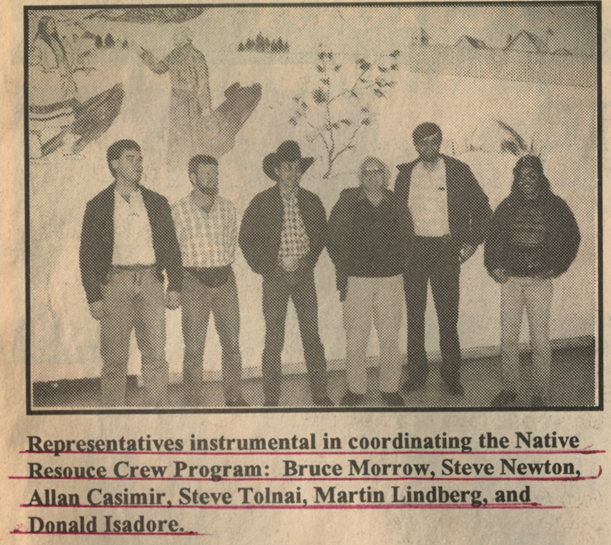
Figure 4. Photograph printed in March 1993 Lex’yem Newsletter displaying representatives from multiple organizations principal in the development of the NRMP’s Native Resource Crew program.
Finally, in terms of institutional flexibility, the structure and content of the NRMP as delivered was distinctly flexible, being formed and revised in active engagement with the professed interests and demonstrated capacity of trainees (Morrow, 1995). Direct participant input was received for consideration not only via student-written assessments conducted following program completion, but also through student-teacher interactions occurring within the program’s duration. Review and analysis of observed patterns of program attendance and absenteeism also informed revisions in program structure, with noted increases in absenteeism occurring within the third week of earlier program iterations engendering the incorporation of an interim two-week break period within successive program schedules to reduce the accumulated strain of commute from home communities for dispersed participants. The development of locally-sited centres for NRMP training – planned at the time of the report’s publication to service multiple Secwepemc Nation communities within the Thompson and Shuswap areas – was forwarded as a longer-term solution to minimize travel from home communities as a condition of program participation. Stressed further towards supporting flexible integration of interested participants was the allowance for unpenalized egress and re-entry into NRMP programs. Considered in sum, the NRMP as described within the summary report appears substantively conformant to the conditions of strong community wildfire resilience described by Abrams et al. (2015).
The NRMP considered in light of recent Native fire stewardship discourse
Programs like the NRMP have arguably accumulated greater pertinency in light of the increasing frequency and severity of wildfire occurrence within North America and elsewhere, with colonially-instituted programs of complete fire-suppression having engendered a legacy of elevated fuel presence and density within environments which, prior to European colonization, had been adapted to periodic low-severity fire resulting both from ‘natural’ occurrence and deliberate Native fire-management practices (Abrams et al., 2015; Hoffman et al., 2022; Copes-Gerbitz, 2021). Importantly, colonial government fire-suppression policy entailed, for a period, the total discontinuation and prohibition of Native cultural burning – practices which are increasingly framed in research as beneficial for wildfire risk reduction and resilience (Hoffman et al. 2022).
Despite these positive evaluations of cultural burning practices, practical and bureaucratic barriers in securing controlled burn conduction – particularly off-reserve – are frequently described in recent literature (Hoffman et al. 2022). The NRMP as it existed in the 90s functionally acted to address a certain ratio of practical barriers through the development of local fire management capacity (Morrow, 1995). In the year following the summary report’s publication, Kamloops This Week reported upon the conduct of a controlled burn at Scheidam by a five-person crew of Kamloops Indian Band members – very likely a NRC crew – with the implied support of the local BC Forest Service (Soodeen, 1996). The considerable linkage and coordination between bands, government agencies, and industry which drove NRMP activities therefore also speaks to circumstances of institutional collaboration which, when developed, likely serve to additionally address bureaucratic barriers in controlled burn conduction (Morrow, 1995).
Conclusions on the NRMP in light of the preceding
Ultimately, attentive consideration of past initiatives such as the NRMP bears substantial import for the development of future land management and wildfire resilience projects, with analysis of program details allowing for the identification of precedents and processes which can be incorporated, revised, and built upon in contemporary initiatives (Morrow, 1995). Further, in considering the network of institutional supports which allowed for the NRMP to function as it did, a clearer sense of the import of institutional changes – such as the discontinuation of funding bodies like Forest Renewal BC – can be rendered, allowing for a holistic consideration of the complex and institutionally-mediated nature of engendering enhanced community wildfire resiliency (Cooperman, 2012; Abrams et al. 2015).
The NRMP was initially a Kamloops-sited initiative, with considerable time and funding expended towards its success; in recent years, KIB – now Tk’emlúps te Secwepemc – has focused considerable energy on commercial development, with few echoes of the NRMP’s community-centred resource management focus apparent in the few publicly-available materials covering the band’s recent endeavours (Tk̓emlúpsemc Forestry Development, 2026; Tk’emlúps te Secwepemc, 2022). Subsequently, the band’s development has seemingly attempted to follow a conventionally prescribed pathway of economic involvement, stressing the leasing of land and construction of infrastructure as means of increasing band-incurred revenues (Tk’emlúps te Secwepemc, 2022). Yet review and analysis of the NRMP summary report renders legible an alternative vision of economic involvement for Native bands – one centring community-scale capacity-building in holistic land-management by stressing the development of practical, widely-employable skills supportive of enhanced wildfire resilience and ecosystem health (Morrow, 1995). Early within the summary report, the NRMP is framed as “only one of many initiatives for First Nations involvement in Natural Resource Management,” further stating that “other avenues and directions are recommended and encouraged” (Morrow, 1995, p. 1). Forwarded implicitly in these words is an acknowledged need for a diverse network of initiatives to support Native participation within land management, for which the NRMP stands as a single, yet nonetheless valuable, example.
References
Abrams, J. B., Knapp, M., Paveglio, T. B., Ellison, A., Moseley, C., Nielsen-Pincus, M., & Carroll, M. S. (2015). Re-envisioning community-wildfire relations in the U.S. West as adaptive governance. Ecology and Society, 20(3).
Casimir, A. (1993). Range Manager’s Report. Lex’yem March 1993.
Cooperman, J. (2012). ‘Forest Renewal’ BC Scrapped. Watershed Sentinel. https://watershedsentinel.ca/article/forest-renewal-bc-scrapped/
Copes-Gerbitz, K., Hagerman, S. M., & Daniels, L. D. (2022). Transforming fire governance in British Columbia, Canada: an emerging vision for coexisting with fire. Regional Environmental Change, 22(2), 48. https://doi.org/10.1007/s10113-022-01895-2
Hoffman, K. M., Christianson, A. C., Dickson-Hoyle, S., Copes-Gerbitz, K., Nikolakis, W., Diabo, D. A., McLeod, R., Michell, H. J., Mamun, A. A., Zahara, A., Mauro, N., Gilchrist, J., Ross, R. M., & Daniels, L. D. (2022). The right to burn: barriers and opportunities for Indigenous-led fire stewardship in Canada. Facets, 7(1), 464–481. https://doi.org/10.1139/facets-2021-0062
Morrow, B. (1995). Native Resource Management Program Summary Report March 1995. Kamloops Forest District, Sage Forestry Ltd. https://docs.google.com/document/d/1aUcmlRkDB-AboznX_L3R2ZvS9QKU-TXZHVT1JVvx1co/edit?tab=t.0
Scwén̓wen. (2026). Tk̓emlúpsemc Forestry Development. Scwén̓wen. https://scwenwen.ca/wdk-listing/tkemlupsemc-forestry-development/
Soodeen, J. (1996, June 12). Scheidam burning a management tool. Kamloops This Week. https://newshound.tnrl.ca/
Tk’emlúps te Secwepemc. (2022). Key TteS Achievements. Tk’emlúps te Secwepemc. https://tkemlups.ca/wp-content/uploads/2022-ttes-achievements.pdf
Tymstra, C., Stocks, B. J., Cai, X., & Flannigan, M. D. (2020). Wildfire management in Canada: Review, challenges and opportunities. Progress in Disaster Science, 5. https://doi.org/10.1016/j.pdisas.2019.100045