
1. An introduction to the Cannery Trade Centre
The Cannery Trade Centre is a former canning factory turned commercial centre located on 1475 Fairview Road in Penticton, BC. Viewed from its exterior, the Centre presents as a unique, jagged-looking building, painted a mix of orange and bluish-grey and capped by an orange triangular roof. Black awnings appear above windows divided in their length by rectangular frames, and a tall reddish-brown cylindrical structure, adjacent to one of the entryways, announces “The Cannery” in vertically stacked serif letters.
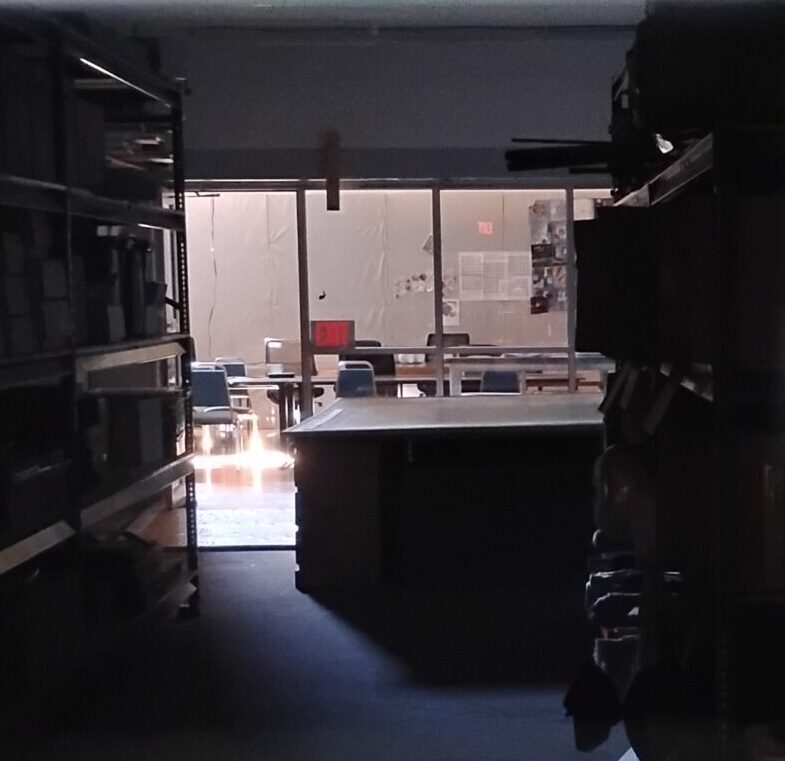
The building’s interior – which is the focus of this piece – consists of a series of elaborately designed, high-ceilinged hallways, painted various colours with burgundy and off-yellow predominating. The hallways are laden with plants, old machinery, and colourful furniture – artistically placed and often emitting a distinctly dated quality. Various businesses emerge from the interior walls, each with their own distinct aesthetic that nevertheless often scans as uncannily complementary to the artistic, eclectic, and unvernacular design of the Centre; accurate or not, one is left with the impression that the Centre has an art director.
The interior to me has a strongly out-of-time feeling, mysterious and otherworldly – an impression accentuated by the circumstances of many of my visits, in which the Centre’s hallways have been largely bereft of human presence. Moreover, I have often found many of the Centre’s intriguing businesses– among them a shoe repair shop, janitorial supply store, art studio spaces, children’s gymnasium, and theatre company – closed during my visits, able to be engaged with only through a look into their windows – producing a feeling of an enchantingly limited peek into a set of potent and implicative dioramic set-pieces . I find even the representations of “normal,” “functional” life within the building – say, as represented by photographs depicting humans – possess a mysterious quality when contextualized by the interior’s design and atmosphere; the images are framed as residual evidence of a shimmering and alternate world, possibly governed by rules and forces distinct from our “own”.
I am always really breath-taken by the Centre whenever I visit, and have been consistently amazed by the new businesses that have been added with each successive trip and how in-keeping they feel with the aesthetic of the interior; each scanning as a perfect new piece of the puzzle. My primary focus here is on the aggregate effect of the Trade Centre’s interior as communicated by the sum of its interrelated parts rather than any individual component (i.e. particular business) of it per se – I am interested in it as a sort of otherworldly art piece, rather than as a vernacular landscape in which to facilitate economic/consumer transactions, and my questions are all informed by this perspective.
2. An introduction to more-than-human geography
My chosen theory through which to analyze and consider the Cannery Trade Centre is more-than-human geography. I was introduced to more-than-human geography in my professor’s Human Geography class last semester, and the theory as described immediately resonated with me, particularly regarding material geography: a subset of more-than-human geography which was said to take seriously the ways in which inanimate objects co-create and influence the environment as experienced. Within the course textbook, material geographies are anchored within the concept of actor-network theory, developed by Bruno Latour, who put forth that manufactured objects – such as sparkplugs or guidebooks – function as “active agents in the ongoing constitution of the world,” equal to humans in their influence (Cresswell, 2013, p. 251). I relate this strongly to my feelings around the Cannery Trade Centre, as the mixture of striking, artistically designed, and often dated-in-association decorative objects – framed within the building’s early-1900s-built interior – produces incredibly strong feelings and associations from me despite – or in part owing to – the dearth or outright absence of synchronous human presence during my visits.
Moreover, a particular portion of Steele & Vizel’s 2014 article “Housing and the Material Imagination – Earth, Fire, Air & Water,” shared in class as an example of more-than-human geography, and linked in full on the course Moodle page, reinforced my sense that more-than-human geography was the correct framework through which to explore my chosen place. The article describes developments within material cultural studies, noting an eventual widening in perspectives on the subject from a rational, pragmatic political economic paradigm – seemingly wholly uninterested in the aesthetic or spiritual facets of manufactured objects – to a new wave of the discipline for which D. Miller’s reframing of kitsch is forwarded as an illustrative example (Steele & Vizel, 2014, p. 78). Steele & Vizel (2014) contrast Miller’s perspective with the established Marxian view, which frames attachment to material possession as a simple case of “false consciousness,” a means of falsely placating populations and supressing awareness of their marginalized positions (p. 78). Miller criticizes the dismissive and condescending framing of kitsch ornamentation as “sentimental… and tack[y],” arguing for the “resonating value” such materials can hold to their possessors, imbuing objects – in Miller’s example, a set of China-sourced facsimiles of antique phones in a belonging-crowded room – with a presence of the “divine” (Steele & Vizel, 2014, p. 78). These thoughts connected with me clearly and simply, articulating something approximate to my feelings surrounding the Cannery Trade Centre as well as many other objects and landscapes dear to me.
Therefore, more-than-human geographies seems the theory most amenable to exploring the aesthetic emotional quality accomplished by both the “deliberate” and “accidental” aspects of the Centre’s design – the former describing the Centre’s actively chosen and designed facets, developed in recent times, the latter encompassing a multitude of phenomena more ambiguous in their intentionality: a set of books and drawing tools left upon a table, residues of past design or architecture designers may want to change but yet haven’t, or the interplay between the interior’s design and that of the businesses within.
3. Three Questions
My three developed questions regarding the Cannery Trade Centre, informed by more-than-human geographic theory, are as follows:
1.
2.
3.
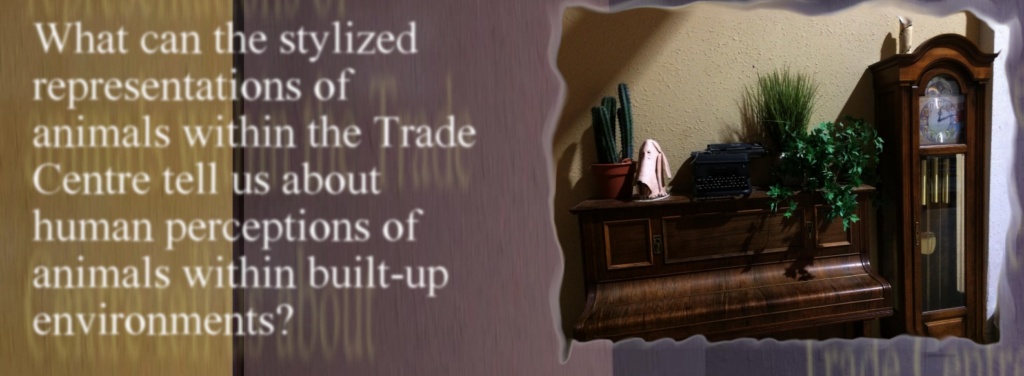
My first question, regarding renderings of animals within human-constructed environments, was influenced by coverage of animal geography (a subset of more-than-human geography) in lecture – particularly the mention that animal geographies could encompass analysis of the meanings evinced from symbolic representations of animals. Our course textbook further expands on this, stating that investigation of human-made animal representations throughout time – and the attendant worldviews and conceptualizations of animals and their relation to humans suggested by said representations – was an early focus among cultural geographers within animal geography (Cresswell, 2013, 246). This recalled for me the symbols of domesticated animals found within the Cannery Trade Centre, one of which I photographed during this semester’s reading week break: namely, a sculptural ornament of a droopy-eyed hound dog laid atop a piano, bookended by typewriter and potted cactus, consideration of which led me to develop this question.
Subsequently, I wished to inquire of the meanings and intentions perceived on the part of humans regarding the hound dog’s placement within the Trade Centre – what does the symbol’s presence say about human perceptions of the place of animals within the Centre? What does the addition of the hound dog add to the emotional landscape of the Centre that wasn’t there before? Does the ornament function on some level – as discussed in the textbook – as a representative proxy of the “animal nature” within the human (Cresswell, 2013, 246)? Is the hound dog placed where it is, consciously or unconsciously, as a sort of intended companion or cohabitant for the Centre’s human patrons? It is these inquiries – which in a sense merge aspects of both material geography and animal geography in their consideration of the part inanimate objects resembling animals play in cocreating environments – that I wished to suggest and consider with my question.
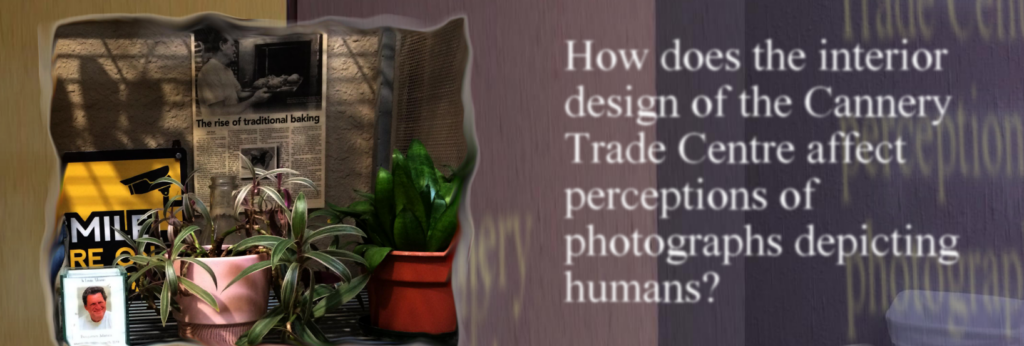
My second question is concerned with the meanings that human-depicting photographs generate as agents in the creation of the Cannery Trade Centre’s emotional landscape, or “network” (Cresswell, 2013, p. 253). My thought here is that photographs can be taken of humans, developed and printed, with these prints then taking on their own air of emotional character or suggestion vastly different from that which would be imparted from the actual corporal presence of the human depicted, creating its own distinct meaning from the spectre of static human presence. Further, my personal feeling was that the contextualization of such photographs within the otherworldly space of the Centre rendered the photographs themselves otherworldly – scanning as glimpses into a different, mysterious world, lost in time and perhaps operating under different rules from our own. This shifted perception, generated by the anchoring of the photographs within the Centre’s distinct space, recalls for me what Cresswell calls, in discussion of actor-network theory, “an outcome of the establishment of networks of connections between heterogenous objects” – with the perception of otherworldliness being the outcome of the connections wrought by this anchoring (Cresswell, 2013, p. 251). At Robin’s suggestion, I widened the questions’ purview past my own personal – humanistic – perspective to allow for a broader set of reactions or perceptions regarding the presence of photographs within the Centre.
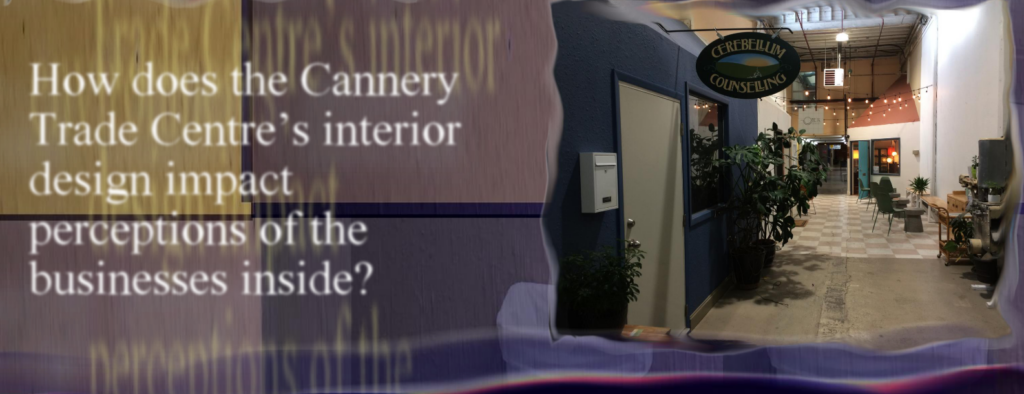
My third question, regarding the ways in which perceptions of the Centre’s businesses are influenced by their enclosure within the building’s hallways, was first drafted as a relational geography question, owing to the idea that the hallways and businesses of the Centre were essentially interrelated through their shared physical attachment, forming together a particular aggregate emotional character dependent on said interrelation. While I feel this relational aspect still forms a large component of my question, I came to perceive that this question fit equally into material geographic/actor-network theory themes regarding the co-constitution of the experienced environment by inanimate materials; I am interested not only in the relationality between the Centre’s individual components – which as our textbook states functionally possess properties “only by virtue of their relationships” – but also the meanings that are created by the sum of these components (Cresswell, 2013, 255).
The specific idea driving this question was that the eclectic and artistic design of the Centre’s hallways served to contextualize the attached business in a manner that curbed perceptions of the businesses as functional, vernacular environments centered primarily or solely around economic and consumer interests, instead framing the businesses as something closer to art pieces within the Centre’s “gallery”. My initial phrasing of the question narrowed in on this idea, but at Robin’s recommendation I broadened the inquiry to better allow for a multitude of emotional responses to the interrelation between the Centre’s businesses and hallways.
4. In which a relational geographic theory is applied to the Centre
Aside from more-than-human geography, the theoretical lens introduced in class that most interested me in relation to my chosen place was relational geography, which as I understand it entails – in part – acknowledgement of a fundamental and non-hierarchical interrelatedness between conventionally distinct/seemingly “contradictory” phenomena; an acknowledgement which is repressed by dualistic thinking (Cresswell, 2013, p. 253). In this regard it possesses similarities with actor-network theory’s concept of the world as composed of connected, non-hierarchical networks of “heterogenous entities” (Cresswell, 2013, p. 253). I see the Cannery Trade Centre as a place in which distinctions are to an extent blurred and complicated; “nature” (as suggested by the preponderance of plants decorating the hallways) and industrial machinery (also strewn about the hallway and repurposed towards decorative function); art (in the Centre’s current design-forward paradigm) and industry (both in the residue of the Centre’s history as a canning factory and in the presence of businesses within the Centre currently, which are necessarily contextualized by their presence within the Centre in a manner distinct from if they were located, say, as a business within a strip mall).
The relational geographic concept of non-representational theory – which partly concerns how the material configuration of spaces can engender distinct pre-cognitive outcomes, as in Peter Adey’s analysis of airport design – also interests me given my impression of the Centre as a space imbuing a strong and distinct emotional response (Cresswell, 2013, p. 233). It is this interest that drove one of my relational geography-focused questions: namely, “How distinct are the pre-cognitive outcomes associated with the Cannery Trade Centre’s interior relative to other interiors within Penticton?”
Informing this question is my perception of the Cannery Trade Centre as a space sufficiently distinct in its emotional atmosphere as to likely produce a cluster of precognitive responses among visitors that are substantially distinct from those which would be engendered by the majority or totality of Penticton’s other interior spaces. If this is so, and if the pre-cognitive outcomes generated from engagement with the Centre are considered broadly desirable, study of what particular arrangement of phenomena produces these emotional responses – what Buser (2014) terms as “affective atmospheres” – could be used in planning to develop spaces producing similar emotional response clusters elsewhere within Penticton or the broader world (p. 228).
As regards to what the nature of these particular precognitive response clusters would entail, I can largely (though perhaps not solely – engagement with other students regarding my poster at a research showcase indicated that my perceptions of the space were somewhat shared and understood by some) only go by my own individual responses which I’ve attempted to articulate within this assignment: a feeling of timelessness, of being brought to bear with a certain mystery and beauty of existence, and of a life-affirming suffusion of the senses – a “joy and possibility of surprising excess” – through engagement with a heterogenous cultural history as reflected by objects, symbols, architecture, and design (Cresswell, 2013, p. 232).
Academic Sources
Cresswell, T. (2013). Geographic thought : a critical introduction. Wiley-Blackwell.
Steele, W. E., & Vizel, I. (2014). Housing and the Material Imagination – Earth, Fire, Air and Water. Housing Theory & Society, 31(1), 76–90. https://doi-org.ezproxy.tru.ca/10.1080/14036096.2013.801362
Vannini, P., & Vannini, A. S. (2023). From heterotopia to alloutopia: more-than-human geographies of Singapore’s underwater Equarius Hotel. Cultural Geographies, 1-15. https://doi-org.ezproxy.tru.ca/10.1177/14744740231218014 (searched various places and could not find volume number attached to this article)
Dekeyser, T. (2017). The gaps of architectural life: the affective politics of Gordon Matta-Clark’s Conical Intersect. Transactions of the Institute of British Geographers, 42(2), 179–191. https://doi-org.ezproxy.tru.ca/10.1111/tran.12166
Alam, A., McGregor, A., & Houston, D. (2020). Neither sensibly homed nor homeless: re-imagining migrant homes through more-than-human relations. Social & Cultural Geography, 21(8), 1122–1145. https://doi-org.ezproxy.tru.ca/10.1080/14649365.2018.1541245
Buser, M. (2014). Thinking through non-representational and affective atmospheres in planning theory and practice. Planning Theory, 13(3), 227–243. https://doi-org.ezproxy.tru.ca/10.1177/1473095213491744