(2025)
YOU: How, or is, the First Nation’s culture represented within planning documents?
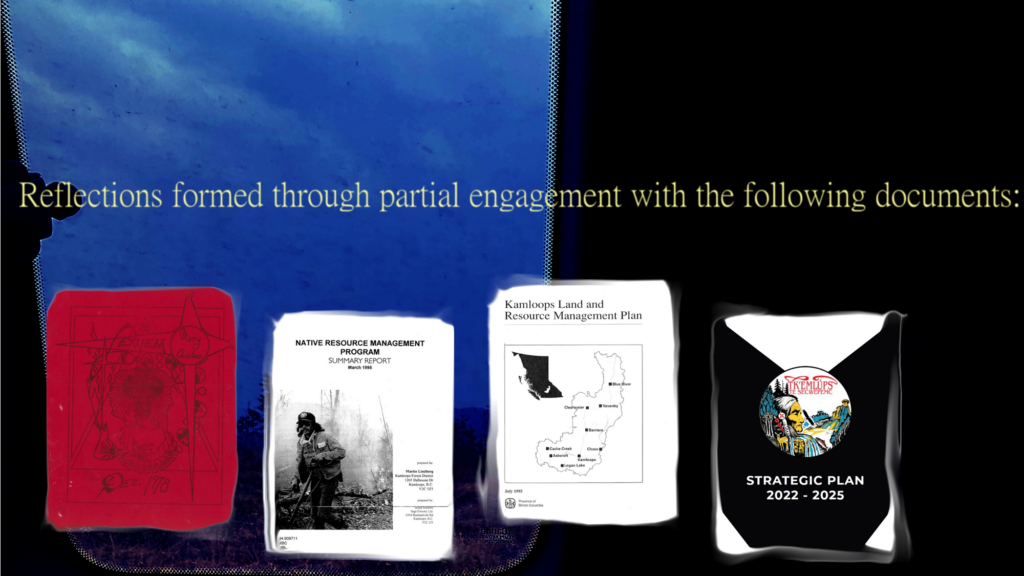
I find this a very complicated and interesting question; the First Nation I am speaking to here is Kamloops Indian Band. In defining what is constituted as a band’s “culture,” I feel I would need to identify what differentiates it from the culture of other bands. Which brings to mind, for one, the development of interior Salish culture and language as discussed within Secwepemc People Land and Laws – having apparently arisen from the influence of coastal Natives emigrating to the interior, folding their own language and culture into those of the preexisting Interior Natives. Secwepemc People Land and Laws is itself a book by Skeetchestn’s Ron and Marianne Ignace, which – like the Kamloops Land and Resource Management Plan – corresponds to a study area potentially encompassing the whole of Secwepemc territory, while being sourced from voices and experiences which constitute only a small fraction of Secwepemc consciousness, to form materials which are collated and edited by a yet smaller fraction. It’s also, I would presume, defined in the mold not only of the authors’ particular sensibilities and reference points, but those dictated in the established mode of academic anthropological publications more generally, and those published as part of McGill-Queen’s Indigenous and Northern Studies series – which the book stands as another iteration in the line of – more specifically.
This will naturally be the case for such endeavours, but it leads one to think what a “truer” representation of a First Nation’s culture could look like, what the limitations would be in facilitating such a thing, and what the requirements would be. Something more like a mosaic with an equal piece filled in by each band member, perhaps – and to me, of the documents I reviewed, the old Lex’yem newsletters come closest to this. I think about the heterogeneity and unevenness of some OutKast songs, where the content and structure of one verse has seemingly nothing to do with those of another, but sometimes reflects something of passion that needed to be said at that time – Big Boi eulogizing his aunt Renee on a short verse on Babylon, completed unrelated to what Andre was talking about earlier. So each piece in such a mosaic would be a time capsule as well, reflective of a particular point in that band member’s life, as well as being dictated by their level of comfort, trust, that they could honestly express themselves. You would see tend to see notable syntactic differences between each person – I think of my uncle Russell’s distinct typing style – which may reflect something particular and ancestral.
YOU: Do you see meaningful, deep, cross-cultural worldviews represented within the process documents you reviewed?
It makes me question what is meaningful and deep and what is surface-level, partial, what is meaningfully representative of Kamloops Indian Band and what is a reflection of the current state of pan-Native trends in consciousness. What is of the band uniquely and what is passed down from Canada’s central core, for one – that’s what comes to the forefront of my mind when reading the recent band-published documents, which do attempt to integrate signifiers of what is currently constructed as traditional Native culture. I think still of Robert Jago (of Kwantlen and Nooksack) speaking on the increasing use of Turtle Island as a sort of pan-Native word for the continent, when it apparently has a more particular source, isn’t really a concept indigenous to Salish nations.
Cross-cultural, this concept, it’s a tangle of yarn, maybe you can’t untangle it.
The Secwepemc Nation’s statement (who wrote it I wonder, was it a multiple cast of writers?) in the Kamloops LRMP, naturally, speaks of ownership and occupancy – the latter making me think of the resource allocation system of First in Time, First in Right, which I associate with the allocation of water resources specifically. It therefore, to me, seems to seek engagement and negotiation on the terms of North America’s ruling class.
The defining hegemonic discourses – of property ownership as the default means of organizing and defining the meaning of land, for instance – define everything in its own image. By necessity, to compete with that level of overriding externalized discursive authority, you need to mirror it, and therefore implicitly validate its attendant constructed understandings of what land is and how it is to be organized and allocated, or that is the popular understanding, anyway.

YOU: Reflect back on the history and culture you explored – how, or is, this present/incorporated in the planning process?
There’s a common valorization of the new in general as a repeating phrase within the world, within the North American context anyway it seems, this idea of accumulating progress, the implication that there is something carried in the word “Indigenous” which renders it more appropriate, respectable, syntactically and semiotically flattering than the past words (“dust collects on the distance runner, the leaves that clog this gutter, clog this gutter” – Sole, Why?, Pedestrian) which lay compacted and implicitly degraded in the ground it feels to me, Indian, Native, Aboriginal, First Nations, looking up at this modern time as if below a transparent barrier of ice, dismayed and humiliated, not just obsolete but presumably in some way offensive, a burden rightly shuffled off the shoulders of the absolutely modern vernacular of our time.
With this narrative – of accumulating progress as engendered through successive revisions – in mind, can the city of Nashville, Tennessee have gone from representing something “genuinely country” to merely superficially “country-flavoured”? Those two words/phrases are attempting to articulate a change that has occurred, owing to various factors, no doubt among them a certain diminishment of regional distinctions with the advent of the internet, which had already been weakened to an attenuated degree by media – television, radio, newspapers – subject to varying degrees of centralized, core-stressing characteristics – consider the influence of central Canada, of Toronto, on our CBC radio that we listen to here. With that in mind, I am left wondering whether the incorporation of traditional Native cultural signifiers within the recent band-published documents truly represent a progression of increasingly concentrated, consequential cultural representation, or if they stand more tantamount to a surface-level template?
So, I felt the most unfettered, raw reflection of Kamloops Indian Band culture came through in the old Lex’yem newsletters from 1978 to 1988, with their heterogenous multi-vocal character – though that is my own biased impression driven in part by my own particular reference points. There’s more of a particular template enacted, I would say, upon the newer band documents I looked at which sand off the edges of difference, besides the fact that the documents have a more narrow, formal, and utilitarian – in the sense that they’re intended to form a framework – purpose than the newsletters, which can be seen as utilitarian in the sense of being a means of providing news and information to band members, but which also bear a recreational and entertainment-centered character.
YOU: How is the land portrayed in any planning documents, legal documents, news articles, etc, spoken about and presented?
Land portrayal; I would say, not with detail, and not with idiosyncrasy, generally, but instead according to a standardized and utilitarian framework, particularly within the Kamloops LRMP, but to an extent with the band documents reviewed as well.
That said, in the Secwepemc Nation’s list of Environmental Protection Interests within the LRMP – what stands out as unique? Not that much – but something called “settlement planning” is listed under land-use zoning/management interests. The ‘gathering’ set of interests seems most culturally distinct; we get to look at a list of eight alphabetized items, including bark, roots, needles. A portrayal of land is formed through description, and through what is mentioned and what is left out – would edible roots – corms and bulbs – make it into the 1995 Kamloops Land and Resource Management Plan without the Secwepemc Nation reminding the creators and the reading public of their interest in such?
Another subsection of interests – settlement and occupation – specifies, traditional occupation sites – imposing a temporal scale upon the plan and its attendant land area that, again, otherwise may not have been there, just through a few words. The concept also, under the same section: “special cultural sites.” Consider wherein this identified value or interest is vested: within a land and resource management plan; and the attendant implication: certain of the areas within the Land and Resource Management Area constitute special cultural sites, and this is expected to be taken as a legible concept, that special cultural sites would be embedded within the land, and it therefore implicitly portrays and frames the land in a particular manner. Does the non-Native populace involved in the creation of the LRMP perceive themselves as possessing a like-set of special cultural sites, that would bear noting within a Land and Resource Management plan? I’m not assuming that they don’t, although the dominant mainstream cultural frame may fail to grant them the language to express it. If they do, what would these sites be, and what would the import be of their existence?
YOU: What questions remain for you about the process?
A lot of the language remains difficult for me to understand; Section 1.3 in the Kamloops LRMP, discussing First Nations Involvement, lists a number of organizations and the processes within which they are engaged; the Shuswap Nation Tribal Council is said to have played a part in planning processes for the LRMP, constituting “one of the levels of government represented” on something called the “Interagency Planning Team,” in addition to SNTC representatives having attended “Interagency Management Committee” meetings as guests, these levels constructed to carry out these processes, which seem to relate to each other sort of how one stair in a staircase relates the one below or above it, related, connected, but not parallel to each other – that’s understandable enough for a staircase, it’s not as understandable here. In general even the presence of words like “jurisdiction” and “title” serve as barriers for my understanding.
Reading Manny Jules’ Chief’s Report’s within the 1987 Lex’yem newsletters also rendered a complicated impression of the processes related to land management, with how much time and energy was spent, on a dizzying number of interactions and process initiations, to gradually chip away at barriers serving to constrict, among other things, the freedom of the band to carry out comprehensive land management. A question arising from that, I suppose is, is this all really necessary? I don’t have an answer for it.
YOU: What impressions do you have about how “successful” the planning might have been when working cross-culturally? Did the planners work cross-culturally from what you can tell?
I think it’s a correct evaluation, as stated by one of the presenters last week, that Native people don’t really have a choice in whether they work cross-culturally, though it’s interesting to consider the ways or contexts within which this could not be the case; there’s an impression of separation to an extent between Native and non-Native communities, that would suggest varying degrees of isolation, cloistering, and perhaps a superficial nature to inter-community interactions.
The Secwepemc Nation Statement of Intent within the Kamloops LRMP has a certain strength and defiance to it, but it begins with what could be seen as a placation or kowtowing to non-Native communities, a throwing up of hands. It’s not a particularly pointed example of it, but it does make me think of Rosanne Casimir recently going on CBC, in relation to news of land claims processes undertaken by the band – and the attendant implication of such as perceived by the Kamloops citizenry – to basically reassure Kamloops citizens that “their” “homes” are not to be taken from them, in the face of discord, narratives, interpretations, in the light also of the recent Cowichan Land decisions.
This dynamic is the primary thing that comes to mind when thinking of “cross-cultural” work. There’s a certain contingent of people who seem to be under the impression that Native communities are accumulating some cascading level of power which will eventually result in impoverished, marginalized conditions for non-Native Canadians – or at least they outwardly claim as much, perhaps with varying degrees of true belief animating their words – but this doesn’t really seem borne out in reality, but the fact that such narratives are expressed, and carry enough discursive force that Rosanne felt a need to address them on CBC, does seem to speak to world within which land-planning initiatives occur – Rosanne in fact I believed stressed that movements taken towards an expanded jurisdictional boundary for the band centre around a desire to gain a stronger footing in land stewardship and management.
In terms of cross-cultural work for the Kamloops 1995 LRMP specifically, apparently the lack of much direct involvement – particularly from individual bands within the LRMP area – apparently owed to a focus on land claims processes at that particular time which many bands felt participation in the LRMP could serve to conflict with. But the LRMP does seem to mark a point in which “First Nations” at least become integrated within a set of stakeholder-related categories which land management practices newly were to be carried out in relation to, with a need to initiate some degree of consultation, in a sort of organized systemized manner, alongside needs to identify “visual sensitivity,” “Mule Deer Winter Range,” and so on – this may be the sort of thing people speak of when they speak of “box-checking” exercises, but it seems it was a new paradigm at the time – just one year after institution of the Forest Practices Code – and, based on my work with Ministry of Forests/BC Timber Sales, it’s still the paradigm people work within today; there’s no identifiable difference in terms of language, categories, the dictated structures of collaboration and consultation, as far as I can tell – it’s all no more, and no less, progressive than what is practiced in environment-based government work today, as far as I can tell.
The LRMP also appears to integrate expressed preferences/demands dictated within the Secwepemc Nation’s Statement of Interest; for instance, the Statement holds that the Secwepemc Nation and its agencies constitute a distinct form of government, not an interest group, and are to be acknowledged as such. Accordingly, a few pages upstream, the Shuswap Nation Tribal Council is described as a level of government rather than an interest group – the preferred framing appears to be accommodated within the text.
I wonder how much of this language would have been legible, parseable, sufficiently parented and rooted, just ten years prior, in 1985? Things were developing, legislation was developing, Bill C-31 was about 10 years prior, and Jeanette Armstrong’s Slash was completed around that time, terminating in the particular developing Native consciousness of that time, post-American Indian Movement, giving way to new trends, the era of wellness centres.
YOU: Consider your sit-spot reflections: how did they impact or factor into your research process? How did they, or did they, change your understanding of how planning could, or should, be done? Do you see value in contemplating the Earth from different viewpoints as, among other things, a way of cultivating deeper appreciation for land-based worldviews?
The first thing that comes to mind, in considering my sit-spot reflections, is the labour inherent to writing by hand as opposed to typing. How does this labour uniquely frame the words relative to if they had instead been typed?
By time-stretching the buffer separating internal thought, and its externalization on the page, more syllables of introspection may have accumulated in the time it takes to write a single word than would be the case if I was instead typing them, potentially.
There would be also perhaps some mechanical difference between hand-writing and typing that may enact a distinct frame upon one’s thoughts, the way jumping-rope may structure your thought-process in a manner distinct from the thought-structures engendered by taking a simple walk. Completing these reflections didn’t consciously change my understanding of planning, but in articulating what was particular and difficult about my creation of the sit-spot reflections just now, I can see it as analogous to the contemplation of land from different viewpoints, which may carry nested within a vastly differing sense of, say, time-scale, in a manner which resultingly frames evaluations of land differently, and results in different means of land management.
YOU: Based on your research process, what are some takeaways that you have about land use planning on Indigenous territory?
It is still muddy to me; I was struck that in a lot of the recent documents from the band there is a not that much focus on land and resource management that I could find – the stress feels more reflective, instead, of the band’s particular era of commercial development; I look upon the businesses accumulating below, Sweleps Market, the new pharmacy, new gas station, the experience of reading the recent documents expresses an atmosphere, for me, similar to the atmosphere emitted through engagement with these new businesses.
YOU: What questions remain unanswered for you and what areas require further understanding? Why is it important to identify that questions remain unanswered and your knowledge remains incomplete?
I don’t see the fullness of what things are, in terms of what Kamloops Indian Band’s culture is, to serve as a basis of comparison when taking in these documents, so I cannot really judge how reflective things are of a given culture; I would need to understand the bounds of that culture first, and I never will be able to fully understand that, but I could understand it on a more comprehensive level than I do now.
Identifying gaps is how you may fill those gaps in – with something, not anything definite or final, and it would be a different thing filled in for each different individual at each point in time, but the possibility of building something is made available through the identification.
YOU: What steps might you take if you were to collaborate with this First Nation on their land use planning?
My father has told me he spoke to many elders prior to and during his development of land management plans once he was hired on by the band as Range Manager; he has mentioned to me their approval following, saying “I like how you did it,” things along those lines, with him speaking in response, that it was on the basis of their guidance that the particulars of his plans were formed.
•There are a few points of particular interest for me within this band’s stretching narrative, as relayed to me, not within these documents for the most part, but through personal experience with family members, one of which is:
- •When out with my father and uncle Russell, there was a particular area we engaged with. It was of particular spiritual significance according to Russell, a certain thickness of import concentrating something of a particular early time within the area, that people would be there and see things, that something ancestral was clustered there.
One thing about the abovementioned is that it seems of a particular distinct and regional character to me, more than smudging, or sweathouses, it feels like this is an inkling of something more particular to our area and band, for which awareness may have largely washed away successively. So, among other things that I could do, which would result mainly from my education in school, I would be interested in exploring and stressing local characteristics or phenomena of this nature, attempting to engage with them and integrating them in what feels like an honest and comprehensive manner, not superficially, creating a framework that expresses and reflects these things.